

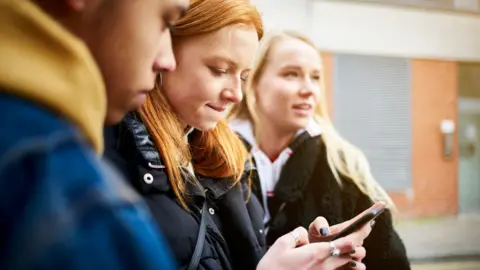
 Getty Images
When I arrived at 10 Downing Street this morning to hear the prime minister announce the UK’s social media ban for under-16s, I had to hand in my phone for security reasons.
The temporary anxiety it gave me was perhaps a small insight into how many of the nation’s 13 to 15-year-olds were feeling, as they too waited to hear the outcome of months of discussion and speculation about their online lives.
Sir Keir Starmer’s news was bold and blunt: yes there will be a ban, yes it will follow Australia’s model and yes, there will be additional curbs which will impact older children, aged 16 and 17, as well.
A night-time curfew is expected to be part of this. The UK’s plan had been dubbed “Australia Plus” and now we know why.
But Australia’s ban has faced well-documented problems, not least because the majority of children who had social media accounts before the ban was enforced in December, still have them.
The response from the UK government is the same answer I hear every time there’s an online safety intervention.
There is talk that the ban will not be a “silver bullet” but will still make some difference.
Sir Keir made several comparisons to laws about drinking alcohol: we know some teens under the age of 18 still drink, but we also know there are plenty of times when the law prevents it.
But we also know 16-year-olds can legally get married, have sex, join the armed forces, and in some parts of the UK, vote in some elections.
Can they not also be trusted on Instagram at night?
Given how many horror stories I have heard during the course of my career about children coming to harm on gaming platforms and forums, it was surprising to learn that they will be exempt.
However they will have to disable livestreaming, as that is included in the ban.
The big question of course is how this is actually going to work.
I did ask the PM but he didn’t directly tell me. Australia’s failing is believed to be in weak age verification methods adopted by the tech companies.
I’ve heard from a couple of fuming industry contacts today that they were under the impression that it would be up to Apple and Google to gatekeep devices (as most people own either an Apple or Android phone).
This would mean when someone aged under 16 sets up a device in the UK, they can’t download banned apps from the app stores.
The people I spoke to are blindsided that this no longer appears to be the case and it will be down to the individual platforms such as TikTok, Snapchat and the rest.
And the deadline for them to figure out a better alternative is short: less than a year to meet the proposed implementation next spring.
Other experts argue that toxic online behaviour is a societal rather than a technology problem, and the blunt instrument of blocking the tech altogether on its own is not the solution.
“Right diagnosis, wrong cure” was the headline of one email in my inbox earlier today.
Facebook launched in the UK 21 years ago, and the other social networks soon followed suit.
This means there’s a generation of young people who have grown up in this world – warts and all.
One reporter at the briefing with me made me feel very old by confiding that YouTube – included in the ban – had been an essential resource for them at school.
I’m still haunted by a message I received from a teenager a short while ago who said without social media they would be dead, because the community they had discovered online had given them reasons to live.
There are of course also many tragic examples of the exact opposite of this.
Campaigners – and government ministers – say the tech companies have had years to do more to protect children, and have failed to do so.
The companies argue they have introduced numerous parental controls and blocked access to features they know to be harmful.
But Sir Nick Clegg, former senior exec at Meta, once said there were so many parental controls that parents were overwhelmed by them and didn’t use them. I think many parents can relate to that.
My sources say the tech companies won’t fight the ban as long as they feel it is fair to all of them – but I’m not convinced all of them do feel that today.
There’s also concern that banning the big mainstream apps will push children into darker, less regulated corners of the internet with fewer or even zero protections in place.
There’s a chance the whole thing could end up in judicial review because of the speed at which it has been rolled out, just a couple of weeks after the closure of an enormous public consultation – which would probably delay it.
There are definite “prime minister’s legacy” vibes about the news, given the broader political picture at the moment.
And finally, there might also be a Donald Trump-shaped obstacle in the road.
Sir Keir hasn’t spoken to him about this yet, but he will see him later on today at the G7 summit where he is now heading.
Trump is protective of his US-based tech companies, and has railed in the past against attempts by other countries to regulate them.
The US government responded to the public consultation insisting that a ban was not the solution.
The same US companies Starmer now seeks to rein in are also investing millions of dollars in their UK operations and infrastructure.
Tech and AI are key priorities in the government’s plans for economic growth. As one former senior government adviser once put it to me, “there is no Plan B”.
The PM has to walk a very fine line between clamping down on them and selling the UK as a good place for them to be. We will see in the coming months whether any of them choose to vote with their feet.


Sign up for our Tech Decoded newsletter to follow the world’s top tech stories and trends. Outside the UK? Sign up here.