Cultural divides
The result is often elevated levels of maternal mortality in remote areas.
As of 2023, the national rate stood at 44.5 deaths for every 100,000 live births, according to Colombia’s Institute of Health. But in departments like Choco and Narino, rates remain significantly higher, with more than 76 deaths for every 100,000 births.
Choco is one of Colombia’s poorest regions. Even when offered free medical appointments, some women are unable to attend because they cannot afford transport.
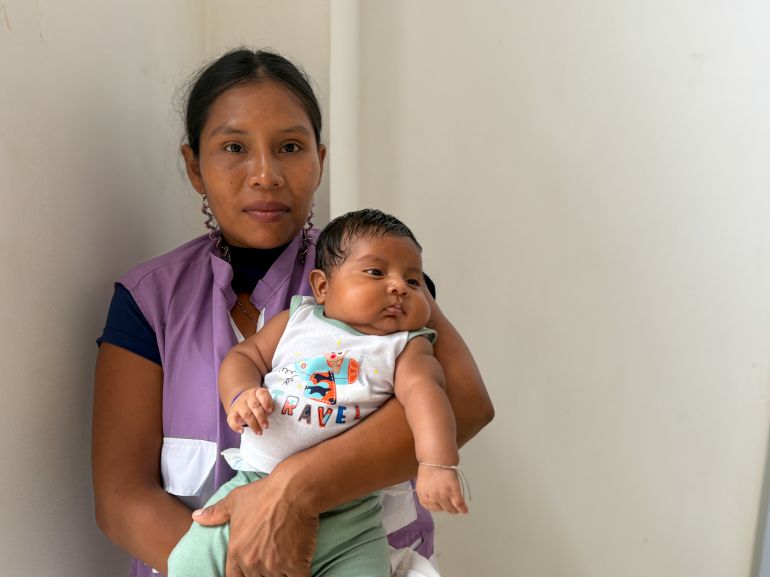
Others fear that their preferences will be ignored. Lucila Caizamo, a member of the Indigenous Embera Dobida community, recently gave birth, and she too is a midwife.
As a coordinator for nearly 230 other parteras spread across several Indigenous communities, she often travels hours by boat — sometimes driving herself — to reach and support them.
But she understands the reticence members of her community face when accessing healthcare. Being unclothed is not customary among her people.

“Some women in Indigenous communities don’t like to go to hospitals to have a baby because they have to strip off naked and expose their intimate parts,” said Caizamo.
At hospitals, women are also often expected to give birth lying flat rather than in upright or squatting positions, as is traditional. Caizamo has heard of cases where doctors ignore their pregnant patients.
“They do not respect the decisions that she wants to make,” Caizamo said.
Faced with barriers to medical access and community distrust, Colombia’s government has increasingly turned to traditional midwives for help.
To support midwives, the United Nations Population Fund (UNFPA) and Colombia’s Agency for Territorial Renewal (ART) have offered community birthing spaces and equipment, such as thermometers and blood pressure monitors.
They also hold joint workshops where parteras can train alongside doctors and nurses.
In parts of Colombia, including Choco, midwives can also receive certification to complete birth notification forms, formally recording the births they witness.