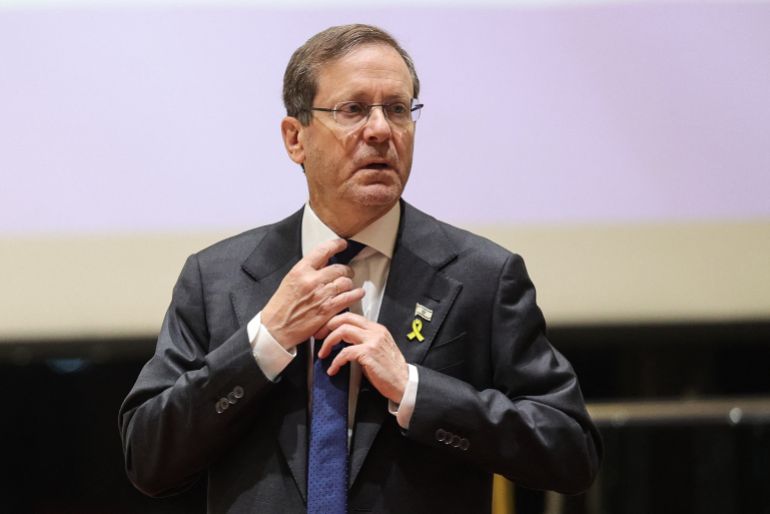
Concerns are being raised about the integrity of Israel’s upcoming general election with politicians, civil society groups and even President Isaac Herzog warning of potential political interference in the vote.
Israelis will ultimately decide the country’s next government and prime minister when they vote in legislative elections on October 27, which will see Prime Minister Benjamin Netanyahu attempt to win another term in office.
Recommended Stories
list of 4 itemsend of list
But there are mounting concerns over the future of Israeli democracy amid apparent attempts by Netanyahu’s government to entrench its power.
A poll by the Israel Democracy Institute found that almost three-quarters of Jewish Israelis were concerned about the integrity of the 2026 election, while 43 percent said they were optimistic about the future of democratic rule in Israel.

Opposition leader Yair Lapid, former Prime Minister Ehud Olmert and President Herzog have all raised concerns about the vote.
In a televised speech in mid-July, Herzog raised concerns about interference in the election and the threat of violence following a meeting with the heads of the electoral commission and internal security service, Shin Bet.
Using biblical stories as examples of the dangers of internecine infighting, Herzog pleaded with the public not to “cross red lines” during the campaign season.
“I turn to elected representatives, activists and all candidates from all parties, and demand that you do not cross red lines. Do not turn rivals into enemies,” Herzog continued. “I call on the people of Israel, in a clear voice: Remember that elections are not a civil war.”
Advertisement
The governing coalition will continue its campaign, begun in 2021, to free itself of judicial oversight, an issue that has bitterly divided the nation. Netanyahu – himself on trial for corruption – is also seeking to defer an independent inquiry into the Hamas-led incursions of October 2023, which led to criticism of his handling of security issues.
Growing international criticism of Israel’s genocidal war in Gaza and settler violence across the occupied West Bank, as well as Israel’s multi-front war against neighbours in Lebanon, Yemen, Syria and Iran, will also be hot topics in the election.
The violence is happening
Israeli Member of the Knesset (MK) Ofer Cassif, who had a no confidence motion in June, told Al Jazeera that violence has become a part of the Israeli political landscape, particularly in the occupied West Bank.
“There’s no need to speculate about the potential for violence, it’s already happening,” he told Al Jazeera. “We’re seeing anti-government activists, and not just Palestinians, but Israelis being arrested and even judges harassed by far-right pro-government militias.”

Ofer said that “problematic” candidates, such as members of his left-wing Hadash Party, were preparing for government attempts to bar them from the election. He also warned of growing unrest in the run-up to election day itself, which could see attempts to suppress voting in areas with large Palestinian citizen of Israel populations, he said.
“Then there’s after the election itself, suppose – purely for analytical purposes – we say it goes against the government. What then? What if they refuse to leave their offices? Who’s going to remove them, Ben-Gvir’s police or Netanyahu’s Shin Bet?” he asked. “They’re already conquered… This is a very dangerous time we’re approaching.“
Perception and reality
There has even been criticism from members of Netanyahu’s right-wing Likud Party, some of whom are against the appointment of Dean Livne as acting head of the Central Elections Committee. MK Avichay Buaron called him “clearly politically biased”, while Diaspora Affairs Minister, Amichai Chikli, said his appointment casts “a heavy shadow” over the election’s integrity.
The coalition has cut the committee’s budget by 50 million New Israeli Shekels (NIS) or (roughly $15m), even though there have been multiple warnings of foreign interference and the risks posed by artificial intelligence in the vote.
Advertisement
The government has been accused of resisting efforts to expand access to voting to care homes. Accusations have also been levelled at the office of Transportation Minister, Miri Regev, of limiting flights into Ben Gurion Airport before election day, which could hinder left-leaning overseas voters from flying into Israel and casting votes against Netanyahu.

“There’s always a tension between whatever governing party is in power and a fair election,” said Therese Pearce Laanela of the intergovernmental electoral monitoring agency, International IDEA. “In the main, their responsibilities are twofold: to ensure the legislation is in place to hold the election and to make the resources available to ensure they’re carried out fairly. What they mustn’t do, is undermine the electoral authority or criticise it in public… There can be a disconnect between perception and reality.”
Political analyst Ori Goldberg said that many Israelis now see Netanyahu as a constant in political life. Some attribute the powers of a “wizard” to him, able to conjure a fresh tactic, or way out of any situation during every Israeli election.
“People always expect Netanyahu to do whatever it takes to stay in power, whatever the cost,” Goldberg said. “Every Israeli election is portrayed as somehow seismic, but this one might actually be. If this coalition is returned to power, it’s Israel telling the world that it’s OK with multiple wars, with enforced starvation – and it’s OK with genocide.”