China faces oil challenge as prices soar and supply options narrow
Beijing is drawing on vast reserves and seeking alternative crude as shipping disruption continues.

 By Caolán Magee17 Sep 2026
Oil prices in China have surged to record highs amid mounting disruptions to exports from the Middle East, as Beijing faces an increasingly difficult balancing act between securing its own energy supplies and preventing global oil prices from climbing even higher.
Saudi Arabia has been forced to shut a key pipeline that had become an important route for getting oil to China and other Asian markets while disruption in the Strait of Hormuz restricted exports through the Gulf. The pipeline, which carries crude across the Arabian Peninsula to the Red Sea, was shut following attacks by an Iran-backed group in Iraq.
end of list
Its closure leaves two vital routes for Middle Eastern oil to China both disrupted in the midst of the US-Israel war on Iran and conflicts in the wider region. With access to Russian and Iranian crude also complicated by United States sanctions and other restrictions, Chinese refiners are being forced to search further afield for supplies. That scramble for available barrels is adding to pressure on oil prices, both in China and globally.
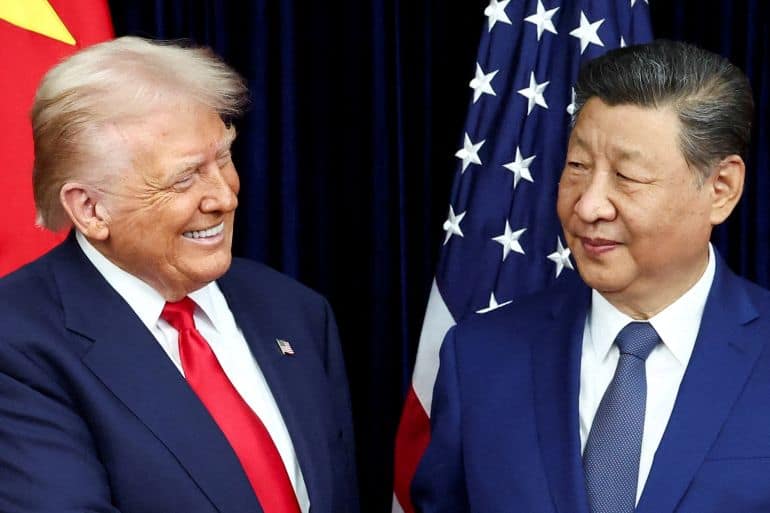
With China increasingly forced to compete for replacement supplies – risking pushing prices still higher – restoring oil flows through the Strait of Hormuz, which Iran has effectively blocked, has become a pressing economic and diplomatic priority for Beijing ahead of talks between Chinese President Xi Jinping and US President Donald Trump, say analysts. The meeting follows talks in Beijing on Wednesday between Chinese Foreign Minister Wang Yi and his Iranian counterpart, Abbas Araghchi.
“What is happening in the Middle East is not good for China,” energy analyst Marc Ayoub told Al Jazeera. “China is in a critical situation,” he said, with refiners increasingly “looking into the market for players outside of Hormuz”.
China helped absorb the first oil shock
Before the war, China was importing roughly 12 million barrels of crude a day and producing another 4.4 million barrels domestically, Reuters reported. It was buying more oil than its refineries needed, allowing Beijing to funnel some of the surplus into vast stockpiles that had grown to an estimated 1.4 billion barrels by the end of last year.
That helped cushion the impact on the wider oil market. As the world’s largest crude importer, China’s decision to buy fewer barrels removed demand at precisely the moment global supplies were being squeezed.
Trita Parsi, executive vice president of the Quincy Institute for Responsible Statecraft, told Al Jazeera, “It lies in their interests that this conflict the United States started does not lead to a global recession.”
“But that [China importing less oil] was not done to undermine the Iranians or help the Americans. The Chinese are pursuing their own interest, and their interest is that the rest of the world should not suffer economically, because if that happens it will backfire on China.”
Crude imports averaged just 8.1 million barrels per day in the second quarter – almost 4 million barrels per day, or 32 percent, lower than in the first three months of the year, according to the US Energy Information Administration (EIA).
But those buffers are now being eroded, and Ayoub said the turnaround was being driven in part by Beijing’s decision to ease restrictions on refined-fuel exports, which had helped keep refinery activity low earlier in the war. “Independent refiners have started looking again for imports from elsewhere,” he said.
As refiners process more crude and stockpiles are drawn down, China is being pushed back into the market for more barrels. “First, they want to increase production from the refineries, and second, they want to build back their inventories,” Ayoub said.
“So the Chinese are trying to find whatever supplies they can get from the market.”
Where can China turn?
Russia is already China’s largest crude supplier, with much of its oil reaching China without passing through the maritime chokepoints disrupting Middle Eastern exports. Reuters reported that Russia supplied approximately 20 percent of China’s crude imports in 2025.
Russian ESPO crude shipped from the country’s Pacific coast can reach Chinese ports in less than a week, while oil also flows overland through pipelines. Chinese refiners have consequently scrambled for available Russian barrels, snapping up September and October ESPO cargoes unusually quickly, experts say.
US sanctions have complicated those purchases, but not stopped them. China’s seaborne imports from Russia reached 1.68 million barrels per day in August, up from 1.4 million in July and the highest since March, according to Kpler data. China also receives about one million barrels per day of Russian crude through pipelines.
Iran had also provided China with a major source of discounted, sanctioned oil before the war. China bought an estimated 1.4 million barrels per day from Iran last year, but those supplies have been sharply curtailed by the conflict and US efforts to block Iranian exports.
China can also look to producers in Latin America and Africa. Brazil was already among China’s five largest crude suppliers last year, and offered China 1.6 million barrels per day in March 2026. Meanwhile, countries including Venezuela, Angola and the Republic of the Congo have historically supplied Chinese refiners.
But there are limits to how easily those barrels can replace lost Middle Eastern supplies. Crude oil is not completely interchangeable, with Chinese refineries configured to process different grades, while substitutes can differ in density. Venezuelan crude, for example, is generally much heavier than the Russian ESPO crude Chinese refiners have been scrambling to secure.
Distance presents another constraint, with Russian ESPO reaching China in less than a week, while barrels brought across the Atlantic from Brazil, West Africa or elsewhere in the Americas face longer journeys and higher freight costs. And alternative producers have only finite amounts available to sell.
Kpler estimates that additional Russian and Iranian supplies can therefore only partially bridge China’s feedstock gap if disruption to Middle Eastern supplies persists.
Saudi Arabia, meanwhile, is trying to keep China supplied, with Saudi Aramco selling at least four million barrels to China in August. But this is only the equivalent of about 129,000 barrels per day when averaged across August.
How vulnerable is China, really?
China’s biggest vulnerability is the sheer size of the gap between the crude it produces and the amount its refineries process.
China produced about 4.34 million barrels per day in August, while its refineries processed 13.91 million, according to Chinese data cited by Reuters. That left a gap of roughly 9.6 million barrels per day that had to be filled by imports or inventories.
However, China is better placed to curb oil consumption than many other major economies. The rapid expansion of electric vehicles has weakened demand for petrol, while electrification has reduced oil use in other parts of the economy. Domestic crude production has also continued to edge higher.
But there are limits to this, with aviation, heavy transport and China’s vast petrochemical industry remaining heavily dependent on oil. So as China raises refinery output and seeks to replenish the stockpiles that helped shield it from the initial shock, it will still have to compete with other buyers for constrained supplies, adding further pressure to prices.
“For crude in particular, they are looking to get any supply that is available in the market out there,” Ayoub said. “That will add pressure, and that will increase prices more.”
The growing pressure on China’s oil supplies has also increased the stakes for Beijing diplomatically, with Chinese Foreign Minister Wang Yi meeting his Iranian counterpart, Abbas Araghchi, in Beijing on Wednesday, calling on Iran and the United States to return to negotiations and urging all parties to reopen the Strait of Hormuz to safeguard international energy supplies.
The talks came a week before an expected meeting between Chinese President Xi Jinping and US President Donald Trump in Washington. US Treasury Secretary Scott Bessent said the leaders would continue discussions on Iran and China’s financial ties with Tehran, with Beijing expected to press Washington to return to negotiations and help end the disruption to shipping and stabilise global oil markets.