Continuity or change? What to know about Colombia’s run-off election
Far-right Abelardo de la Espriella and leftist Ivan Cepeda compete for the presidency with starkly different platforms.
Save


Published On 18 Jun 202618 Jun 2026
Voters in Colombia are preparing to head to the polls for the second time in less than a month to decide who will be the South American country’s next president.
But the two candidates competing in Sunday’s run-off offer starkly differing visions for the country’s future.
Recommended Stories
list of 3 itemsend of list
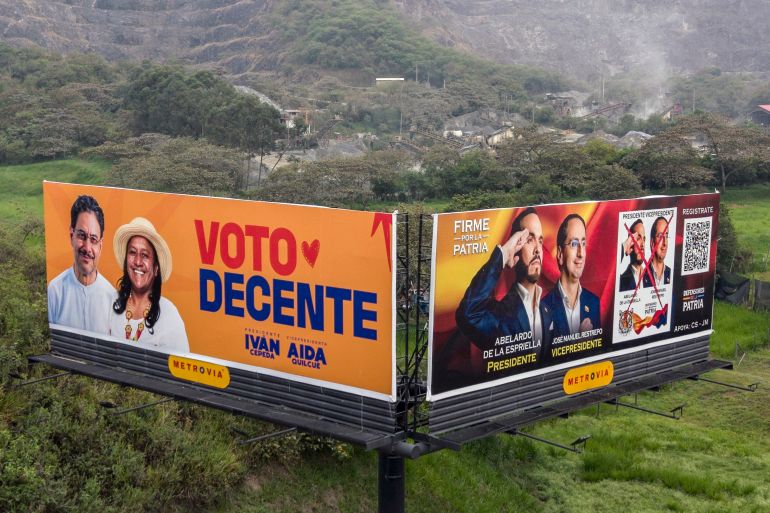
One candidate, left-wing Senator Ivan Cepeda, has pledged continuity with the government of outgoing President Gustavo Petro, who championed anti-poverty measures and negotiations with the country’s armed groups.
The other, far-right outsider Abelardo de la Espriella, has promised a break from establishment politics, including a swerve away from negotiated solutions and towards more military-led responses to crime and violence.
De la Espriella emerged with a small advantage over Cepeda in the first round of voting on May 31, earning 43 percent of the vote compared with the senator’s 40 percent.
Margins are once again tight going into the second round, but pre-election polls show de la Espriella ahead of Cepeda.
Who are the two candidates, what issues are animating the election, and what can we expect during the second round of voting? We answer those questions and more in this brief explainer.

When is the election?
The run-off vote will take place on June 21.
What happened during the first round of voting?
Cepeda had been leading in the pre-election polls ahead of the May 31 general election.
Advertisement
But in an upset, de la Espriella came in first place with 43.7 percent of the vote. Cepeda trailed with 40.9 percent. Neither, however, secured a majority of 50 percent or more to avoid a run-off race.
The surprise outcome led President Petro to accuse private firms of manipulating the election results in favour of the right-wing candidate.
“As president, I do not accept the results of the preliminary count,” Petro wrote on social media shortly after the results were tallied.
Initially, Cepeda appeared to echo Petro’s scepticism, but he later conceded that there were no irregularities in the first round of voting.
The European Union’s Election Observation Mission also affirmed that there was no evidence of malfeasance in the election.
What can round one tell us about round two?
De la Espriella is believed to have an advantage coming out of the first round of voting.
In the general election, right-wing voters were split between different candidates, including de la Espriella, conservative Senator Paloma Valencia and centrist Sergio Fajardo.
Now, in the second round of voting, de la Espriella is expected to consolidate some of the voters who previously cast their ballot for Valencia and Fajardo.
The first round also revealed a geographical divide between the regions that supported Cepeda and the regions where de la Espriella won.
Majorities in coastal and border regions, as well as in the capital Bogota, voted for Cepeda. But central departments, which have been hard hit by Colombia’s internal armed conflict, tilted towards de la Espriella.
Who is Ivan Cepeda?
Senator Ivan Cepeda is running as the nominee for the country’s left-wing governing coalition, known as Historic Pact.
Cepeda has promised to continue with Petro’s efforts to reduce social and economic inequality.
But one of the prevailing issues in this year’s election has been security, as Colombia continues to contend with its six-decade-long internal conflict.
Petro has sought to defuse that conflict through negotiations with armed groups, as part of a policy called “Total Peace”.
While Cepeda has pledged to reform “Total Peace”, he has backed the policy overall as a needed departure from decades of militarised approaches and rights abuses.
Petro’s approach, however, has faced criticism for failing to stem the conflict, with incidents of violence on the rise in recent years. The International Committee of the Red Cross, for instance, said the number of people displaced by violence doubled in the last year.
But Cepeda has brought his own experiences with Colombia’s conflict to the election.
Advertisement
His father, also a senator, was assassinated in 1994 in a shooting that was widely believed to be carried out by government-backed paramilitary groups. Afterwards, Cepeda dedicated himself to advocacy on behalf of the victims of “state crimes”.
As a senator, Cepeda also accused a powerful former president, Alvaro Uribe, of collaboration with right-wing paramilitary groups. His allegations launched a years-long court case that briefly saw Uribe convicted of bribery and witness tampering, before the verdict was overturned.
Who is Abelardo de la Espriella?
Facing off against Cepeda is a candidate from the far right who is, in nearly every way, his opposite.
Criminal defence lawyer Abelardo de la Espriella has no previous political experience, though he has used that fact to his advantage, portraying himself as a successful businessman.
De la Espriella founded a self-named clothing brand as well as a restaurant in South Florida, and he has also forged a career as a tenor, releasing classical-pop albums.
Running with the Defenders of the Homeland Party, de la Espriella has pledged a hardline approach to security. His platform includes ending all negotiations with armed groups and bombing their camps.
He has also proposed the construction of 10 mega-prisons and would restart aerial fumigation efforts to kill the crops used to make cocaine.
His supporters argue such a hardline approach is necessary to rein in Colombia’s violence.
“Of course, whenever you come down with a heavy hand, there’s always going to be debate,” voter Maria Eugenia told The Associated Press (AP) news agency. “But some people are going to have to fall to clean up what needs to be cleaned up.”
Colombia has long been a close ally in the United States-led “war on drugs”, and de la Espriella has pledged he will work closely with US President Donald Trump to ensure regional security.
In the realm of economic policy, de la Espriella has been compared to Argentina’s libertarian President Javier Milei, who has pushed forward a programme of sweeping austerity and deregulation.
What’s at stake?
While Cepeda has campaigned on continuity with the current government, experts warn that a victory of de la Espriella could send Colombia veering in an uncharted direction.
De la Espriella’s platform would see Colombia withdraw from some international institutions, including the Inter-American Court for Human Rights, and he has proposed rolling back the right to access abortion, as part of his conservative social platform.
But some of the most intense scrutiny has fallen on his security policy. Critics question whether his iron-fisted, military-led approach will exacerbate the violence Colombia already faces.
“We’re a country that has lived through 60 years of conflict,” sociologist Juan Acevedo told the AP news agency during the first round of voting. “The danger here is that we return to the times where everyone is saying that the only way to solve our problems is with bullets and more war.”
What do polls say?
De la Espriella is expected to hold an advantage going into the run-off, with polls consistently putting him in the lead.
Advertisement
The research firm AtlasIntel, for instance, released a poll on June 13 showing de la Espriella with 50.9 percent of the vote, with another 43.1 percent going to Cepeda.
Roughly 5.9 percent of voters, however, said they either did not know who to vote for or planned to nullify their votes. Those undecided and protest voters could be critical in determining the outcome.
Critics also underscore that polls do not necessarily predict the outcome of any race. After all, in round one of Colombia’s presidential election, it was de la Espriella who trailed in the polls — but he ultimately landed in first place.
What has Donald Trump said about the election?
Trump has repeatedly endorsed right-wing candidates in Latin America’s elections, and he has continued that trend with Colombia.
Following de la Espriella’s success in the first round of voting, Trump congratulated the far-right candidate and compared himself to the 47-year-old.
“Abelardo fights tirelessly for, and loves, his Great Country and People, just like I do for the United States of America,” Trump posted on Truth Social on June 10.
“Because of his tremendous accomplishments in life, and his political support for me, it is my Honor to give Abelardo my Complete and Total Endorsement.”
In his post, Trump expressed affinity for de la Espriella’s hardline platform on crime, drug trafficking and immigration, priorities he shares.
He also blasted Cepeda as a “Radical Left Marxist” and suggested that Colombia’s relationship with the US could be set back if the left-wing candidate wins.
“The results of this Election are very important to the future of Colombia and its relationship to the United States which, if Abelardo wins, and because of his competence and love of his Country, will have the total support and strength of the United States behind him,” Trump wrote.
De la Espriella responded with a social media post of his own, thanking Trump.
“With my head held high and a heart full of patriotic gratitude, I receive your words and your steadfast support,” de la Espriella said.
But Trump’s endorsement has triggered concern that he might seek to influence the outcome of Colombia’s election.
On Wednesday, US Representative Jesus “Chuy” Garcia issued a statement calling Trump’s actions “shameless interference”.
“Our government must respect, not undermine, the democracy and sovereignty of our neighbors in the region,” Garcia wrote.