Election results so far – and what’s still to come
Paul Seddon,Political reporterandBecky Morton,Political reporter

 PA Media
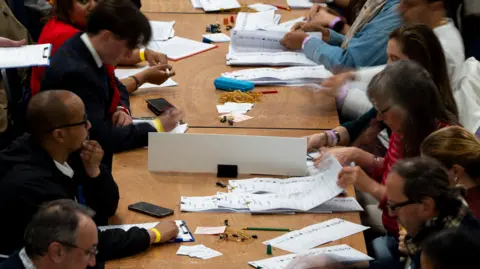
Reform UK has made significant gains at the expense of Labour and the Conservatives in council election results in England so far.
Results are also coming in from parliamentary elections in Wales and Scotland, with Labour admitting defeat in Wales and the SNP claiming victory in Scotland.
The polls across Scotland, Wales and 136 English local authorities are the biggest set of elections since the 2024 election, and widely seen as a crucial test of Sir Keir Starmer’s premiership.
Here are the key developments so far – and what’s still to come.
Reform gains and Labour losses
 Getty Images
Reform UK has been picking up seats in former Labour heartlands in the north of England and the Midlands, such as Wigan, Bolton, Salford and Halton.
Reform’s surge has seen Labour lose majority control in areas including Redditch, Hartlepool, Tameside, Hyndburn, and Cannock Chase.
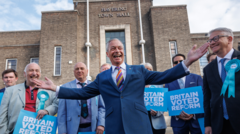
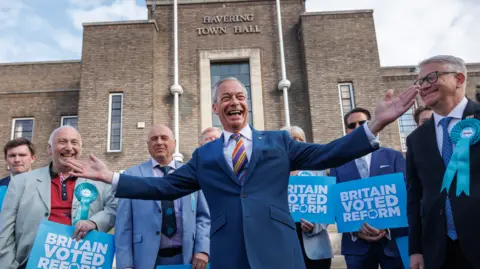
Nigel Farage’s party has also made gains at the expense of the Conservatives, seizing control of Newcastle-under-Lyme, Suffolk, and Essex, which hosts the parliamentary seats of half a dozen shadow ministers.
Reform also won control of Havering, which borders Essex, delivering the party its first-ever win in a London borough.
The party was in its infancy the last time these councils were up for election, meaning it is only possible for the party to win majority control in areas where all seats are being contested.
Reform and Plaid battle in Wales
Labour has already admitted it is on course for defeat in the Senedd election, bringing to an end a century of political dominance for the party in both Westminster and Cardiff Bay.
Such is the scale of the party’s expected wipeout, even Eluned Morgan, Labour first minister since 2024, is at risk of losing her seat.
Reform UK and Plaid Cymru have won the most seats in the first few constituencies to declare in the middle of Friday afternoon, and are hoping to replace Labour as largest party in the expanded 96-seat parliament.
Meanwhile, the Greens have won their first Senedd seat, and the Liberal Democrats are aiming to increase their number from a single seat.
While Wales is not traditionally an area of strength for the Conservatives, the party looks set for considerable losses.
SNP aims for fifth term in Scotland
SNP leader John Swinney says his party will be the largest in the Scottish Parliament and therefore win an unprecedented fifth successive term, although most seats are yet to call.
Scottish Labour leader Anas Sarwar says there has been a “national wave” of disappointment with his party. It has taken Na h-Eileanan an Iar and Edinburgh Southern from the SNP, but the final result does not look good for them.
Reform UK – which currently has no representation in Holyrood – is yet to win a constituency seat among those that have declared, but is hoping to do well in seats allocated from the regional list.
The Scottish Conservatives admit they will not retain second party spot, whilst both the Greens and the Liberal Democrats are hoping to make gains, as the dominance of main parties fragments.
Tories continue to struggle
In early counting, the Tories won back control of Westminster from Labour and gained seats to become the largest party on Wandsworth Council again.
But those results, in two previously flagship London councils, are bright spots in an otherwise poor set of results for the official opposition so far.
The Conservatives have been losing seats to Reform in places like Brentwood and North East Lincolnshire – and in Hampshire, where it has lost control of the council for the first time since 1997.
Having already lost control of Suffolk and Essex to Reform, the Tories face a threat from the party in Norfolk, expected to declare early on Friday evening.
Meanwhile, in parts of southern England including Surrey and Sussex, the Tories face a challenge from the Liberal Democrats.
Greens eye gains in London
 Getty Images
Green Party of England and Wales has won its first-ever mayoral race in Hackney, a post that has only previously been held by Labour since its creation in 2002.
The east London borough is also a key target for council elections, along with other inner London areas such as Lewisham and Newham, which are not expected to declare results until later on Friday.
Outside of the capital, the party has picked up some seats in places like Salford, Oxford, Southampton and Exeter, where Labour lost control of the council.
It also made 17 gains among the 32 seats up for grabs in Manchester, where a third of the Labour-controlled council’s seats were up for election.
It is also hoping to break through in Wales under the Senedd’s new proportional voting system.
Mixed bag for Lib Dems
It has been a mixed set of results for the Liberal Democrats so far.
They won control of Stockport and Portsmouth, where they were already the largest party, picking up seats from Labour, and posted gains in Sutton and Richmond-upon-Thames, two south-west London strongholds.
But in Hull, Reform UK gains saw the Lib Dems lose control of the council.
They had held hopes of winning control of Tory-run Hampshire, but a Reform surge meant that, despite Lib Dem gains, no party is in overall control there.
The Lib Dems are hoping to win control of the two new councils in Surrey, which are being elected in “shadow” form before formally taking power next year.
Other council results to come
Having taking control in Havering, Reform UK is also hoping to make gains in another outer London borough, Barking & Dagenham, which declares later.
For the Conservatives, Barnet in north London, is another flagship council they are hoping to win back from Labour.
Elsewhere, Reform UK is targeting former Labour strongholds in the north of England and the Midlands like Sunderland, Gateshead and Walsall.
In Birmingham – where the council is currently run by Labour – the new fragmented political landscape is on full display.
All the five main parties have a presence and with polls suggesting strong support for pro-Palestinian independents, the result later could leave the city under no overall control for the first time in more than a decade.


Sign up for our Politics Essential newsletter to keep up with the inner workings of Westminster and beyond.