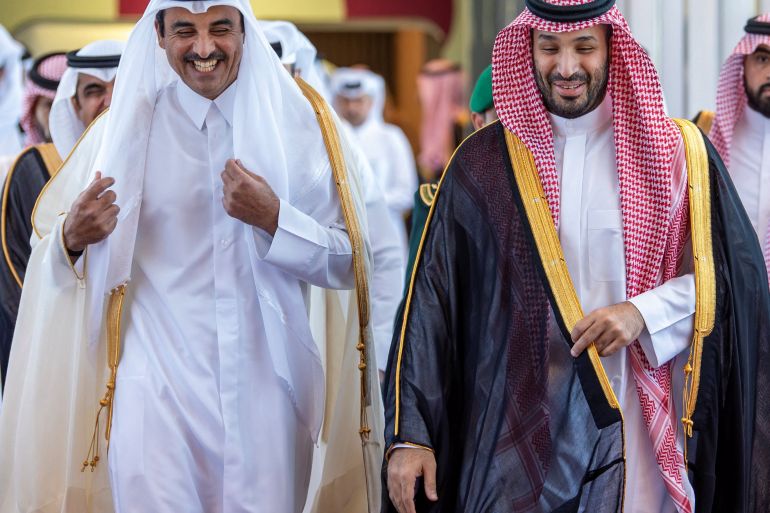
Gulf leaders meet in Saudi Arabia for first time since start of war on Iran
High-level GCC summit in Jeddah embodies ‘unified Gulf stance’ towards the war, Qatar’s emir says.
Save


Published On 28 Apr 202628 Apr 2026
Gulf leaders have gathered in Saudi Arabia to discuss a regional crisis triggered by the United States-Israel war on Iran, their first in-person meeting since the outbreak of the conflict two months ago.
The Gulf Cooperation Council (GCC) leaders were greeted by Saudi Crown Prince Mohammed bin Salman as they arrived in Jeddah on Tuesday, according to images released by Saudi state media.
Recommended Stories
list of 4 itemsend of list
“During the summit, a number of topics and issues related to regional and international developments were discussed, as well as the coordination of efforts in response to them,” the Saudi Press Agency (SPA) reported.
Among those in attendance were Kuwaiti Crown Prince Sheikh Sabah Al-Khaled Al-Hamad Al-Sabah, Bahrain’s King Hamad bin Isa Al Khalifa and Qatari Emir Sheikh Tamim bin Hamad Al Thani, the SPA said.
The summit embodied “the unified Gulf stance” towards the war and the need to intensify coordination in pursuit of a diplomatic path forward to preserve the security and stability of the region, Sheikh Tamim said in a social media post after the meeting.
The talks took place as the US considers an Iranian proposal to end the war and reopen the Strait of Hormuz, a crucial waterway that has essentially been closed during the war, disrupting the global economy.
The six energy-rich GCC countries – Bahrain, Kuwait, Oman, Qatar, Saudi Arabia and the United Arab Emirates – have stressed that the Strait of Hormuz, through which one-fifth of the world’s oil and liquefied natural gas supplies pass during peacetime, must reopen and any deal must result in a permanent, long-term arrangement.
Advertisement
The talks in Jeddah also coincided with the UAE announcing a decision to withdraw from OPEC and OPEC+ to focus on “national interests”, dealing a heavy blow to the oil-exporting groups.
Earlier on Tuesday, Qatar’s Ministry of Foreign Affairs cautioned against the possibility of a “frozen conflict” in the Gulf.
“We do not want to see a return to hostilities in the region anytime soon. We do not want to see a frozen conflict that ends up being thawed every time there is a political reason,” spokesperson Majed al-Ansari said.
During the war, Iran has attacked key energy infrastructure in all GCC states, which maintained a defensive posture against the salvoes of missiles and drones launched towards them. US-linked firms, other civilian infrastructure and military installations were also targeted.
Attacks have subsided since the US and Iran entered a ceasefire on April 8 although Gulf countries remain wary of resumed conflict as a permanent deal between the US and Iran to end the war has so far been elusive.