Israel’s ‘two-tier’ policing and the crime epidemic in Palestinian towns
Murder rates in Israel’s Palestinian areas soar, fueling allegations of state complicity and neglect.
Save

 By Simon Speakman CordallPublished On 2 May 20262 May 2026
Addressing the cameras following reports of spiralling youth violence, including the killing of the 21-year-old former Israeli soldier Yemanu Binyamin Zalka last week, Israel’s National Security Minister Itamar Ben-Gvir was clear.
“This will be a total war,” he said, announcing a national operation to target a surge in youth violence. “We will restore security to the streets and calm to parents. Anyone who harms Israeli civilians will face the strong hand of the Israel Police and pay a heavy price.”
Recommended Stories
list of 4 itemsend of list
The response was sharp, aligned itself with the victim, and promised a solution.
That, critics say, is a sharp contrast to Ben-Gvir’s response – or lack of one – to the ongoing epidemic of violence in Israeli towns and villages populated by Palestinians, which has so far led to the deaths of almost 100 people and, according to Israel’s own finance ministry, costs the country up to $6.7bn a year.
Allegations of two-tier policing, to the detriment of what Israelis refer to as the “Arab sector”, have dogged Israel’s police for decades. But the situation has gotten worse under the current administration of Prime Minister Benjamin Netanyahu, which has been in power since the end of 2022, and Ben-Gvir, a far-right politician who is in charge of the police.
The statistics since Ben-Gvir came into office back up the narrative that the crime wave in Palestinian communities has gotten significantly worse. The Israeli newspaper Haaretz reported that the murder rate in Israel’s Palestinian communities increased from 4.9 per 100,000 in 2020, to 11 per 100,000, on par with the murder rate in Sudan and Iraq.
Advertisement
In contrast, the murder rate in Israel’s Jewish society stood at approximately 0.6 per 100,000.
That increase can not totally be attributed to the current government – Netanyahu himself was prime minister in 2020, when the murder rate was lower. But critics argue that the introduction into government of figures like Ben-Gvir and Finance Minister Bezalel Smotrich, who they say are openly disdainful of Palestinians, has contributed to the sharp uptick in violence.
Analysts and experts who spoke to Al Jazeera had little doubt over the Netanyahu government’s culpability in the increased murder rate.
“They really don’t mind that Palestinians are killing each other, as they’ve been left to do for years,” lawmaker Aida Touma-Suleiman, a Palestinian member of the Hadash party and a longstanding critic of the lack of policing in Palestinian communities in Israel, said.

“It would never occur to the police that they should provide a service to Arab neighbourhoods,” she said of the lack of physical police presence within Palestinian communities. “It’s about enforcement. It’s hostile.”
While police stations are standard in Israel’s Jewish-majority areas, there are only about 10 in Palestinian-majority areas.
Among the decisions that have most angered Palestinian advocacy groups in Israel was the government’s December approval of a $68.5m cut to an economic development programme for Palestinian communities in Israel, in order to fund more policing in the communities.
Critics agreed that more funding was needed for the police, but bemoaned that the money was coming from a fund designed to address the root causes of criminality by addressing housing and economic development, areas where Palestinian communities are notoriously underfunded in comparison to Jewish ones.
Hardwired poverty
Palestinian citizens of Israel make up around 21 percent of the country’s population. Disadvantaged economically, they are the descendants of Palestinians who did not flee after the 1948 establishment of Israel – an event they know as the Nakba, when an estimated 750,000 Palestinians were ethnically cleansed and forced out.
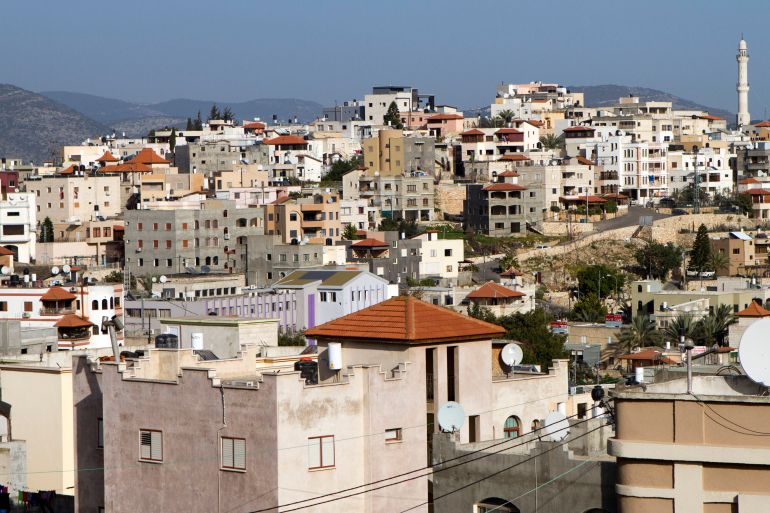
Often concentrated in separate towns and villages from Israeli Jews, Palestinians frequently describe a reality of chronic underinvestment, with the presence of the state either limited or non-existent.
Advertisement
Joblessness has long been woven into their daily lives, analysts say, but the unemployment rate has worsened since Israel choked off access to the occupied West Bank, where many worked, after the Hamas-led October 7 attack on Israel and the start of Israel’s genocidal war on Gaza in 2023.
The most recent official date, based on 2024 figures, shows that 37.6 percent of Palestinian households in Israel live below the poverty line.

Local criminal networks in Israel’s Palestinian towns and villages have grown in scale and influence in recent years, in some cases taking on the form of mafia-style organisations, untroubled, critics say, by the current government.
“There is a wide network of criminal gangs who exert control across Arab neighbourhoods,” said Daniel Bar-Tal, professor of social-political psychology at Tel Aviv University, adding that criminality and even murder were allowed to continue with the state’s own complicity.
“In part, the government just likes it. They get to say, ‘Look, this is Arab culture, this is Arab society. This is what they do.’ They also rely on the collaboration of the gangs to gather information on what’s going on in these communities,” he said, referring to numerous accounts of how friends who had reported criminal activity in their neighbourhoods were dismissed. “And lastly, it is because the police force is controlled by Ben-Gvir, a racist who actively enjoys dehumanising Arab society.”
Ben-Gvir has previously rejected accusations of racism and says he is only against those who harm Jews.
Policed by the enemy
From leveraging his position in government to urge on the genocide in Gaza, to defending officers under his charge filmed raping a Palestinian prisoner, Ben-Gvir’s actions have dismayed many of Israel’s self-styled liberals, just as they have shocked observers around the world.
However, following an uptick in crime in Israel, criticism of Ben-Gvir’s performance in his role as national security minister has begun to enter the domestic mainstream.
As well as more predictable opinion pieces in Israel’s liberal press, accusing the National Security Minister of being “busy on TikTok” while Zelka was killed, or concentrating his efforts on arresting professors wearing Palestinian flags on their kippahs while murder rates break records, there have also been criticisms from those closer to the establishment.
Earlier this month, Israel’s High Court intervened in a row between Ben-Gvir and Attorney General Gali Baharav-Miara, ordering the two to reach an accommodation after Baharav-Miara called for his ousting following what she claimed was his attempts to make political interventions in the police’s work.
“Nobody cares if Ben-Gvir’s good at his job,” political scientist Ori Goldberg said. “He’s there to punish Palestinians, even those in Israel. They’re punished through a lack of security, just as they’re punished through hostile planning, and a lack of healthcare punishes them. This is how the apartheid Israel always works.”
Advertisement