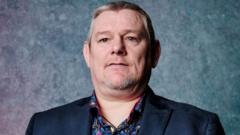
Tourette’s campaigner says BBC ‘should have worked harder’ to stop his slur being aired
Steven McIntoshEntertainment reporter

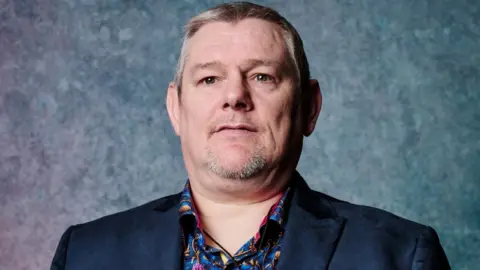 Getty Images
Tourette’s campaigner John Davidson has said the BBC should have “worked harder to prevent anything that I said” at the Bafta Film Awards being broadcast, and questioned why he was seated near a microphone.
Davidson, whose condition involves involuntary tics, shouted a racist slur while black actors Michael B Jordan and Delroy Lindo were on stage at Sunday’s ceremony.
Davidson told Variety: “I remember there was a microphone just in front of me, and with hindsight I have to question whether this was wise, so close to where I was seated, knowing I would tic.”
The BBC reiterated that the offensive language “arose from involuntary verbal tics associated with Tourette syndrome”, adding: “We apologise that this was not edited out prior to broadcast and it has been removed from BBC iPlayer.”
On Tuesday, the corporation’s chief content officer Kate Phillips told staff that another racial slur had been edited out of the broadcast.
In contrast, the one shouted when Lindo and Jordan were on stage “was aired in error and we would never have knowingly allowed this to be broadcast”, she said.
Davidson, from Galashiels in Scotland, said he shouted about 10 different offensive words during Sunday’s ceremony as a result of his tics, but the media coverage has given the impression the N-word was the only one.
Variety reported that he has contacted Warner Bros in order to apologise directly to Jordan, Lindo and Sinners production designer Hannah Beachler, who also spoke about hearing racial slurs.
Meanwhile, Google has apologised after sending a news alert about the story which included the N-word.
“We’re very sorry for this mistake,” the company said of the computer-generated alert. “We’ve removed the offensive notification and are working to prevent this from happening again.”
Davidson told Variety that the studio behind the film I Swear, which tells the story of his struggles with Tourette’s, held discussions with Bafta before the ceremony about the possibility of his ticking.
“StudioCanal were working closely with Bafta, and Bafta had made us all aware that any swearing would be edited out of the broadcast,” he said.
“I have made four documentaries with the BBC in the past, and feel that they should have been aware of what to expect from Tourette’s and worked harder to prevent anything that I said – which, after all, was some 40 rows back from the stage – from being included in the broadcast.”
‘Comprehensive review’
Awards ceremonies often have microphones placed at various spots around the auditorium, to pick up ambient crowd noise as well as applause and cheering.
In a statement on Monday, Bafta said it acknowledged the “harm this has caused, address what happened and apologise to all”.
In a letter to its members on Tuesday, the organisation said it wanted to “assure all our members that a comprehensive review is under way”.
After shouting the slur, Davidson said he chose to leave the auditorium “so as not to cause any more upset”, adding that Bafta found him a private room with a monitor to watch the rest of the ceremony.
Davidson said he “had as much right to attend as anyone”, as the subject and executive producer of I Swear, which was nominated for five awards.
“I also knew that as voting members, most people in the audience would have seen I Swear and would be well prepared, well educated and well informed about my condition,” he said.
Davidson said he was “aware of how physically and mentally difficult it would be for me to attend”, adding: “I can’t begin to explain how upset and distraught I have been as the impact from Sunday sinks in.”
‘The opposite of what I believe’
In his interview with Variety, Davidson also said: “I want to be really clear that the intent behind them [the tics] is zero. What you’re hearing is a symptom – not my character, not my thought, not my belief.”
He said he felt a “wave of shame an embarrassment” after shouting the racial slur.
“Tourette’s can feel spiteful and searches out the most upsetting tic for me personally and for those around me,” he explained. “What you hear me shouting is literally the last thing in the world I believe; it is the opposite of what I believe.
“The most offensive word that I ticked at the ceremony, for example, is a word I would never use and would completely condemn if I did not have Tourette’s.”
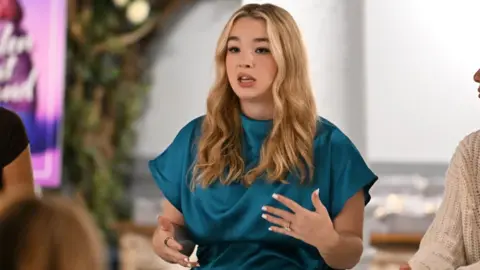 Getty Images
Several figures in the Tourette’s community have also sought to explain the condition.
Writing on Instagram, Baylen Dupree, star of US reality series Baylen Out Loud, explained: “Tourette’s doesn’t pull from hatred – it often pulls from anxiety, from fear, from the very thing you’re most scared of saying.
“The brain misfires on what feels charged or taboo. It doesn’t excuse the hurt a word carries. Words matter. History matters. Pain matters. But so does neurological reality.”
BBC News understands the producers editing the ceremony for its delayed BBC broadcast were doing so from a TV truck and simply did not hear the slur shouted when Lindo and Jordan were on stage.
But Channel 4’s former head of news and current affairs, Dorothy Byrne, rejected that defence in an interview with BBC Radio 4’s Today programme on Wednesday.
“John needed a BBC person next to him at all times to support him, but also to relay and be aware of anything that he said,” Byrne reflected.
“So there needed to be, in the written plan, a means by which the people in the truck would be aware of what happened in the room.”
‘Deeply traumatising’
Former BBC News executive and Conservative communications chief Sir Craig Oliver said the TV truck defence was “kind of entering into the dog-ate-my-homework territory”.
“It’s increasingly obvious that we live in a time where there are going to be controversial things at live events, and there is going to be potential reputational damage to the BBC,” he said.
“So does it have that grip, does it have that process in place? And increasingly it seems like the answer is no.”
Meanwhile, BBC Radio 1 DJ Oré Olukoga has expressed his disappointment with how the situation has been handled by the corporation.
Olukoga, the station’s early weekend breakfast host, wrote on X that the “incident at the Baftas and the reaction to it has been deeply traumatising”.
“I understand all the nuances at play and would never want to minimise someone’s plight, but as a Black man who works for the BBC, I am deeply, deeply disappointed in how it’s been handled,” he said.